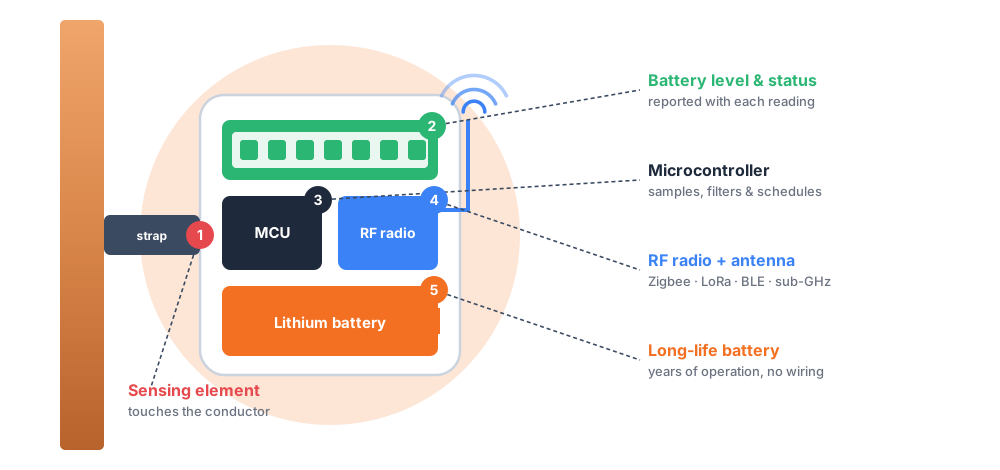
As Industry 4.0 and digital transformation accelerate across manufacturing, power generation, and data centers, traditional wired temperature monitoring is rapidly becoming obsolete. Manual thermography and cabled sensor networks can no longer meet the demands for real-time visibility, predictive maintenance, and operational efficiency in modern industrial environments.
In 2026, the following three major developments are defining how enterprises deploy, manage, and benefit from battery-powered RF temperature monitoring across their critical electrical assets:
1. Battery-Powered RF Sensors: Eliminating Wires Without Sacrificing Reliability
Cumbersome wired thermocouples and PT100 sensors are being rapidly replaced by battery-powered RF wireless temperature monitoring systems that transmit data over Zigbee, LoRaWAN, Wi-Fi, or proprietary radio bands. These self-contained sensors attach directly to busbars, breaker contacts, and cable lugs—eliminating the need for cable trays, conduit, or power taps inside crowded electrical compartments.
The global wireless temperature sensor market is projected to exceed $4.7 billion by 2032, with battery-powered RF systems capturing the majority share in industrial applications. The shift is fueled by three converging forces: the declining cost of RF chipsets, the availability of 10-year lithium battery chemistries, and the maturation of low-power wide-area network (LPWAN) protocols.
Why Enterprises Choose Battery-Powered RF Wireless Sensors
- Rapid Deployment: No cabling, no conduit, no electrical shutdowns required for installation
- Scalable Architecture: A single gateway can aggregate data from hundreds of sensors across large facilities
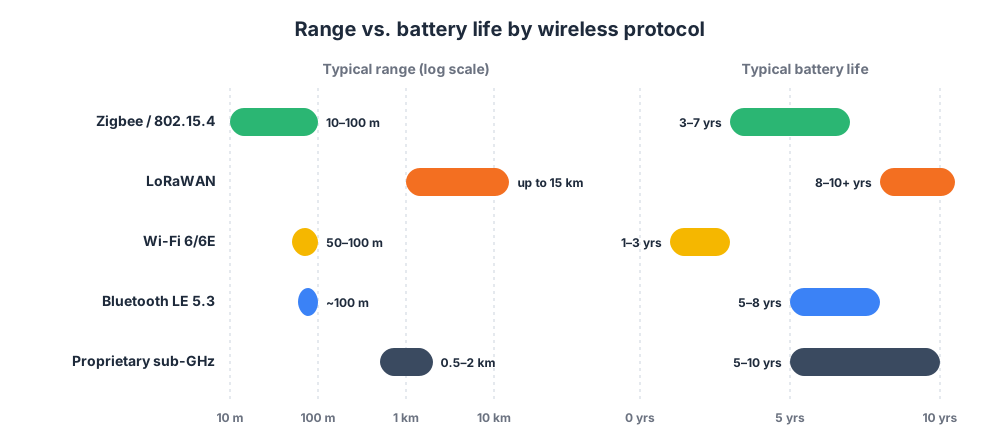
- Long Battery Life: LoRaWAN sensors operate 8–10+ years; Zigbee sensors 3–7 years on standard lithium cells
- Harsh Environment Ready: IP67-rated housings withstand dust, moisture, and temperatures from -40°C to +125°C
- High-Voltage Compatible: Non-conductive enclosures and galvanic isolation enable safe use inside live switchgear up to 36 kV
RF Protocol Comparison for Industrial Temperature Monitoring
| Protocol | Range | Battery Life | Best For | 2026 Status |
|---|---|---|---|---|
| Zigbee / 802.15.4 | 10–100m (mesh) | 3–7 years | Dense sensor networks, indoor switchgear | Mature, widely adopted |
| LoRaWAN | Up to 15km | 8–10+ years | Large substations, outdoor yards, campuses | Fastest growing industrial protocol |
| Wi-Fi 6/6E | 50–100m | 1–3 years | High-data-rate applications, real-time video | Emerging for IIoT edge devices |
| Bluetooth LE 5.3 | ~100m | 5–8 years | Mobile diagnostics, proximity maintenance | New standard with improved range |
| Proprietary Sub-GHz | 500m–2km | 5–10 years | High-EMI environments, custom security | Specialized industrial use |
Enterprises that have deployed battery-powered RF wireless temperature monitoring consistently report: 60–80% reduction in installation costs, 40–70% fewer emergency shutdowns, and near-elimination of thermal blind spots that previously relied on quarterly manual infrared inspections.
2. AI-Driven Predictive Maintenance: Turning RF Sensor Data into Actionable Intelligence
Traditional temperature monitoring relies on periodic manual readings or simple threshold alarms—approaches that catch failures too late or generate excessive false positives. In contrast, modern battery-powered RF wireless temperature monitoring systems stream high-frequency thermal data directly to cloud platforms where machine learning algorithms analyze patterns, predict degradation, and prescribe maintenance actions before temperatures reach critical levels.
Because battery-powered sensors operate autonomously for years without human intervention, they provide the continuous, gap-free datasets that AI models require for accurate training and inference. A sensor reporting every 30 seconds generates over 1 million data points per year—far more than any manual inspection program could ever capture.
How AI Transforms RF Temperature Data into Business Value
- Anomaly Detection: Machine learning models identify subtle thermal signatures that precede failures by days or weeks—patterns invisible to simple threshold rules
- Load-Temperature Correlation: AI correlates thermal trends with electrical load profiles, ambient conditions, and seasonal variations to distinguish normal operation from incipient faults
- Automated Maintenance Scheduling: Predictive algorithms rank assets by failure probability and recommend optimal maintenance windows—minimizing both downtime and unnecessary truck rolls
- Remaining Useful Life (RUL) Estimation: Advanced models estimate how long a busbar joint or breaker contact will remain within safe operating temperatures, enabling capital planning and risk prioritization
Key Advantages of Battery-Powered RF Sensors for AI Applications
- Uninterrupted Data Streams: No wiring failures or power outages disrupt data collection; battery backup ensures continuous monitoring during electrical maintenance
- High-Frequency Sampling: Configurable reporting intervals from 10 seconds to 1 hour capture transient thermal events that wired systems with slow scan rates miss
- Distributed Edge Intelligence: Modern sensors include onboard processing to filter noise, detect local anomalies, and transmit only meaningful events—extending battery life while improving AI input quality
Through battery-powered RF wireless monitoring + AI predictive maintenance, facilities transition from reactive "fix when it breaks" strategies to proactive "fix before it breaks" operations—reducing unplanned downtime by up to 70% and extending electrical asset life by 10–15 years.
Ready to Deploy Battery-Powered RF Temperature Monitoring?
Discover how wireless RF sensors with 10-year battery life can transform your predictive maintenance strategy.
Request a Demo Explore RF Sensor Specs3. Cloud-Native Automation & Real-Time Compliance: 24/7 Visibility Without Human Intervention
As regulatory requirements tighten across power utilities, data centers, and manufacturing, real-time temperature monitoring has evolved from a best practice to a compliance mandate. Battery-powered RF wireless systems address this need by delivering automated, audit-ready thermal records without the labor burden of manual logging or the infrastructure cost of wired networks.
Automated Compliance Capabilities
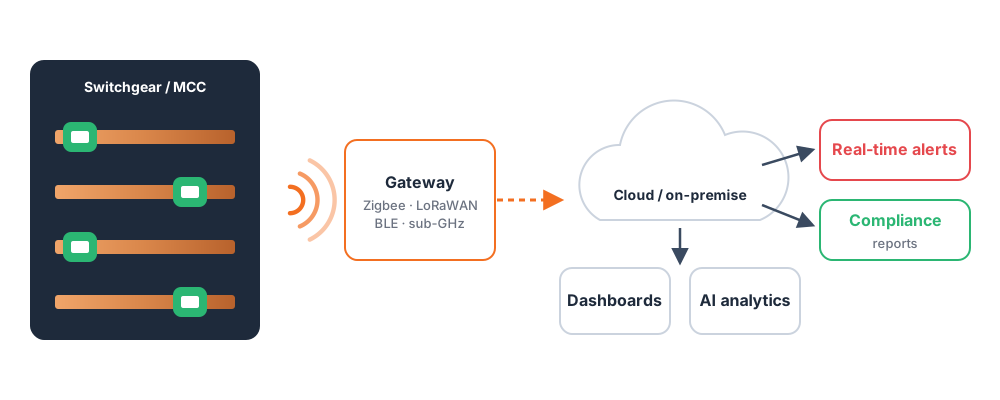
- Real-Time Alerts: Instant SMS, email, or SCADA notifications when any sensor exceeds configurable thresholds—enabling sub-minute response to thermal anomalies
- Digital Audit Trails: Every temperature reading is timestamped, geotagged, and cryptographically signed—creating tamper-proof records for regulatory inspections and insurance claims
- Automated Reporting: Daily, weekly, and monthly compliance reports generate automatically in PDF or Excel format, eliminating hours of manual data compilation
- API Integration: RESTful and MQTT APIs push data directly into enterprise CMMS, ERP, and building management platforms—unifying thermal data with broader asset management workflows
Manual vs. Battery-Powered RF Automated Monitoring Comparison
| Capability | Manual / Wired Monitoring | Battery RF Automated Monitoring |
|---|---|---|
| Data Frequency | Quarterly or monthly inspections | Every 10 seconds to 1 hour, 24/7 |
| Error Rate | High (human oversight, transcription errors) | Negligible (automated digital capture) |
| Installation Cost | High (cabling, conduit, electrical work) | Low (magnetic or adhesive mount, no wiring) |
| Compliance Reports | Manual compilation, prone to gaps | Auto-generated, audit-ready, continuous |
| Response Speed | Hours to days (detected at next inspection) | Seconds (real-time threshold alerts) |
| Scalability | Limited by wiring complexity | Unlimited (add sensors without infrastructure) |
| Maintenance Burden | High (battery replacement, cable checks) | Minimal (5–10 year battery life, remote diagnostics) |
By integrating battery-powered RF wireless temperature monitoring into cloud-native industrial platforms, enterprises achieve true 24/7 autonomous thermal surveillance—ensuring no critical hotspot goes undetected, no compliance gap emerges, and no maintenance opportunity is missed.
ROI: Why Battery-Powered RF Monitoring Pays for Itself
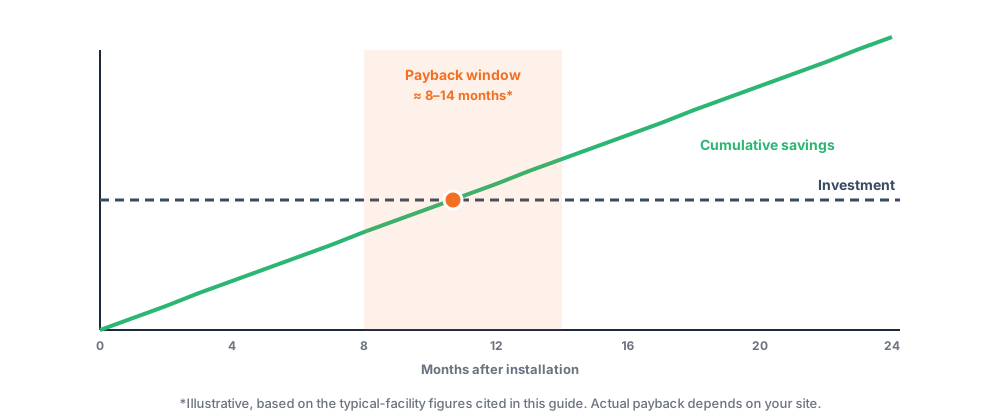
For facilities managing medium- or high-voltage electrical distribution, the business case for battery-powered RF wireless temperature monitoring is compelling. A typical 50 MW industrial facility investing $45,000–$65,000 in a comprehensive RF sensor network typically achieves full payback within 8 to 14 months through avoided downtime alone.
Quantifiable Financial Benefits
- Avoided Downtime: Unplanned outages in critical facilities cost $5,000–$50,000 per minute. RF monitoring reduces emergency shutdowns by 40–70%
- Installation Savings: Eliminating cabling, conduit, and electrical labor cuts deployment costs by 60–80% compared to wired systems
- Energy Efficiency: Identifying high-resistance connections reduces I²R losses by 2–5%, saving thousands annually in large facilities
- Insurance Premium Reduction: Underwriters increasingly discount premiums for facilities with documented predictive thermal monitoring programs
- Extended Asset Life: Operating busbars and breakers within design temperature limits extends equipment lifespan by 10–15 years
- Labor Optimization: Automated monitoring eliminates quarterly thermal imaging surveys, freeing maintenance teams for higher-value work
Conclusion: The 2026 Blueprint for Wireless Thermal Management
The Three Pillars of Modern RF Temperature Monitoring
As battery-powered RF wireless technology, AI predictive analytics, and cloud-native compliance automation converge, temperature monitoring in Industry 4.0 is no longer just a "safety check"—it has evolved into a strategic infrastructure layer for reducing costs, improving efficiency, and ensuring continuous operational resilience.
For enterprises managing switchgear, busbars, transformers, and critical electrical distribution, the question is no longer whether to adopt wireless RF monitoring, but which protocol, platform, and integration strategy will deliver the fastest return on investment. The facilities that deploy battery-powered RF intelligence today will be the ones that eliminate thermal surprises, minimize unplanned downtime, and maximize asset availability tomorrow.
The future is wireless, intelligent, and autonomous. With 10-year battery life, kilometer-range RF protocols, and AI-powered cloud analytics, there has never been a better time to upgrade from wired limitations to wireless freedom.
Deploy Battery-Powered RF Temperature Monitoring Today
See how wireless RF sensors with 10-year battery life and AI cloud analytics can protect your critical electrical infrastructure.
Schedule a Free Assessment View Technical SpecsFrequently Asked Questions
Battery life in wireless RF temperature sensors typically ranges from 3 to 10 years depending on the protocol, transmission frequency, and battery capacity. LoRaWAN sensors offer the longest battery life (8–10+ years) due to low power consumption, while Wi-Fi sensors may require replacement every 1–3 years. Zigbee sensors generally last 3–7 years with standard AA lithium batteries.
Wireless range varies by RF protocol: Zigbee offers 10–100 meters with mesh networking, LoRaWAN reaches up to 15 kilometers in open environments, Wi-Fi covers 50–100 meters, and Bluetooth LE extends approximately 100 meters. For industrial switchgear and busbar applications, Zigbee and LoRaWAN are most commonly used due to their ability to penetrate metal enclosures and operate reliably in high-EMI environments.
Yes, modern battery-powered RF temperature sensors are specifically engineered for high-voltage switchgear environments. They feature non-conductive housings, galvanic isolation, and robust RF protocols that resist electromagnetic interference. Many sensors are rated for medium-voltage applications up to 36 kV and include IP67 or higher ingress protection to withstand dust, moisture, and extreme temperatures found in industrial electrical compartments.