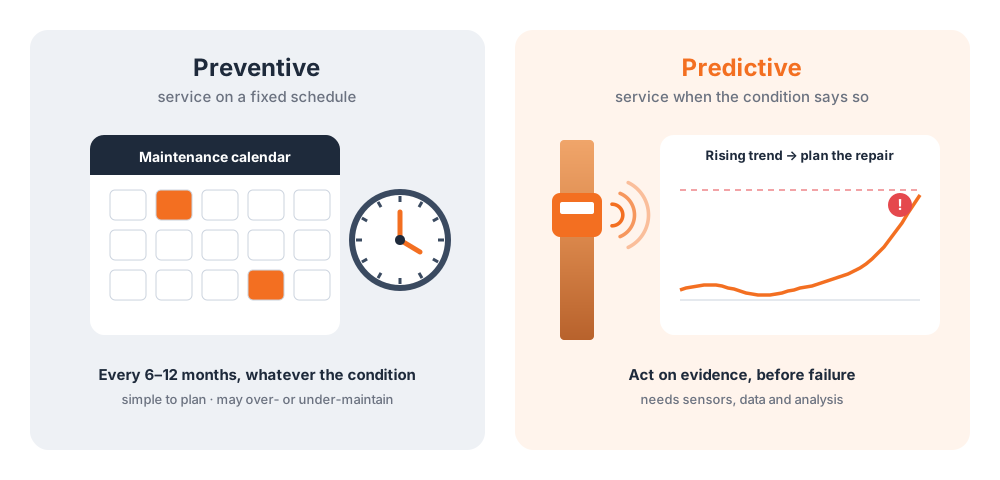
Preventive maintenance services equipment on a fixed schedule, whatever its condition. Predictive maintenance uses condition data and trends to service equipment only when it shows signs of deterioration. Preventive is simpler and suits statutory tasks; predictive targets work, cuts unplanned outages and suits critical assets with measurable warning signs. Most facilities use both.
Key takeaways
- Preventive maintenance is triggered by time; predictive maintenance is triggered by condition and trends.
- Predictive maintenance is part of the wider preventive family, not its opposite, and the two work best together.
- Predictive only works where failures give a measurable early warning, such as joint temperature, partial discharge or breaker timing.
- The P-F curve shows why: earlier detection gives a longer window to plan repairs during scheduled outages.
- Choose asset by asset, based on criticality and detectability, and start with a pilot on your highest-risk equipment.
Predictive vs. Preventive Maintenance at a Glance
| Preventive maintenance | Predictive maintenance | |
|---|---|---|
| Trigger | A fixed schedule (time, operating hours or cycles) | The asset’s measured condition and trend |
| Question it answers | “Is it time for service?” | “Does this asset need attention, and when?” |
| Data needed | Manufacturer guidance and service history | Continuous or frequent condition data plus history |
| Typical electrical tasks | Cleaning, re-torquing, IR surveys, breaker tests | Online temperature, PD and breaker monitoring, trending |
| Main risk | Over-maintaining healthy assets; missing failures between visits | Needs sensors, data quality and people to act on alerts |
| Best for | Statutory tasks, consumables, failures without warning signs | Critical assets with measurable early-warning signs |
What Is Preventive Maintenance?
Preventive maintenance is planned maintenance carried out at fixed intervals (calendar time, operating hours or number of operations) to reduce the chance of failure. The interval normally comes from the manufacturer’s guidance, applicable standards and the site’s experience, adjusted for environment, duty and age.
For electrical assets, a preventive program typically includes:
- Visual inspection and cleaning of switchgear, panels and bus ducts
- Checking and re-torquing bolted busbar and cable connections
- Periodic infrared (thermographic) surveys of energised equipment
- Insulation resistance and contact resistance testing
- Circuit breaker exercise, timing and trip testing
- Replacing consumables such as filters, batteries and gaskets
Its strength is predictability: work can be scheduled into planned outages, budgets are easy to forecast, and nothing depends on sensors or software. Its weakness is that the calendar doesn’t know the equipment’s actual condition. Healthy assets get opened up unnecessarily, which costs money and can itself introduce faults, while a connection that starts deteriorating a week after an inspection may go unnoticed until the next one.
What Is Predictive Maintenance?
Predictive maintenance (PdM) uses condition data, collected continuously or at frequent intervals, together with operating context and asset history, to detect developing problems and decide when to intervene. Instead of servicing everything on a timetable, the maintenance team acts when the data shows an asset is deteriorating, and leaves healthy equipment alone.
Predictive maintenance doesn’t forecast an exact failure date. What it does is give early, evidence-based warning: for example, a busbar joint whose temperature has risen 12 °C above the other two phases over three weeks at similar load. That leaves time to plan a repair during a scheduled outage instead of reacting to a failure.
Reactive, Preventive, Condition-Based and Predictive Maintenance
These terms are often presented as rivals, but they are better understood as steps on a spectrum. Each adds more data to the decision about when to act:
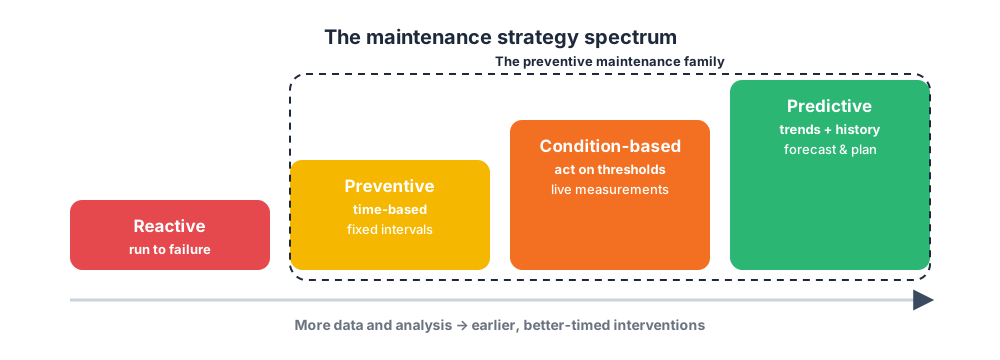
- Reactive (run-to-failure): repair after something breaks. Simple, but failures are unplanned and often cause collateral damage. Industry sources such as ABB estimate reactive maintenance can cost up to 10 times more than a planned program.
- Preventive (time-based): service at fixed intervals, whatever the condition.
- Condition-based: act when a live measurement crosses a threshold, such as a joint temperature exceeding its warning limit.
- Predictive: combine condition data with trends, operating context and history to anticipate when action will be needed, often before any threshold is reached.
Some vendors add a further step, prescriptive maintenance, where software also recommends the specific action. In practice, most facilities run a mix: predictive on critical assets, preventive on the rest, and run-to-failure only where a failure is cheap and safe.
Predictive vs. Preventive Maintenance: Key Differences Explained
| Factor | Preventive maintenance | Predictive maintenance |
|---|---|---|
| Timing | Predetermined intervals | When the condition indicates a need |
| Information used | Age, manufacturer intervals, service records | Live measurements, trends, load, history |
| Upfront cost | Low: labour and tools only | Higher: sensors, receivers, software, setup |
| Running cost | Steady, can include unnecessary work | Lower labour per asset; work targeted where needed |
| Downtime | Planned, but may be more frequent than needed | Planned, and only when the data justifies it |
| Failures between visits | Can go undetected until the next inspection | Detected as they develop, 24/7 |
| Skills | Standard maintenance skills | Plus data interpretation and alarm management |
| Safety | Requires opening and working near equipment more often | Fewer intrusive checks on energised equipment |
| Records and audits | Inspection reports at intervals | Continuous trend history and alarm records |
Pros and Cons of Each Approach
Preventive maintenance
Advantages:
- Easy to plan, budget and staff
- No investment in monitoring hardware or software
- Well understood and often required by standards, insurers or manufacturers
- Covers failure modes that give no measurable warning
Disadvantages:
- Healthy equipment is serviced unnecessarily, and every intrusive task carries a small risk of introducing a fault
- Problems that develop between visits are missed
- Intervals are averages and don’t reflect each asset’s actual load or environment
- More outages and more work near energised equipment
Predictive maintenance
Advantages:
- Problems are found early, while they are cheap and safe to fix
- Maintenance effort is focused on the assets that need it
- Fewer unplanned outages and less collateral damage
- Continuous records support root-cause analysis, audits and insurance
- Data can justify extending intervals on healthy assets
Disadvantages:
- Upfront cost for sensors, communications and software
- Only works for failure modes with measurable precursors
- Needs good data quality, sensible alarm settings and a process for acting on alerts
- Requires some data-interpretation skills, or a supplier who provides them
The P-F Curve: Why Timing Matters
Reliability engineers use the P-F curve to explain why predictive maintenance works. Most failures don’t happen instantly. There is a point P where a potential failure first becomes detectable, followed by a period of deterioration before the functional failure F. The time between them is the P-F interval: the window in which you can plan an intervention.
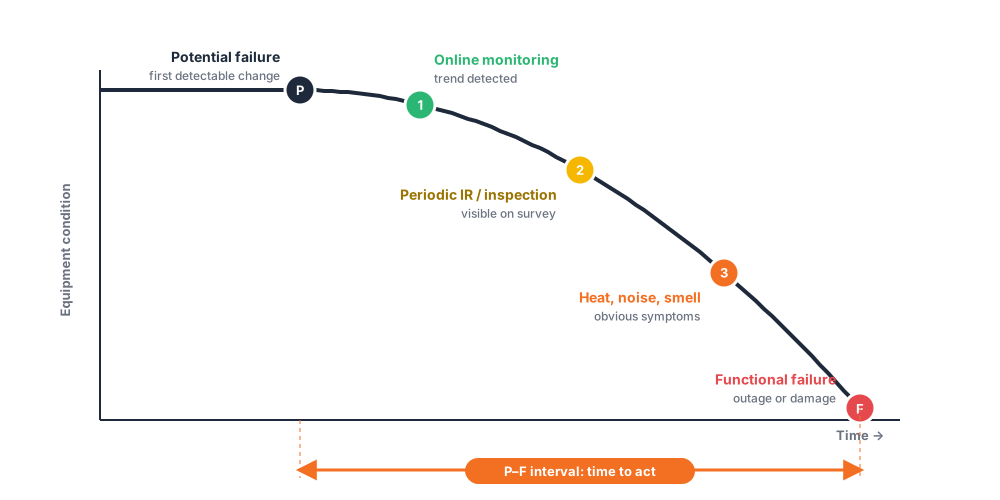
The earlier a technique detects the change, the more of that window you get. Continuous monitoring typically sees a rising joint temperature long before a periodic thermography survey would, and much earlier than smell, noise or discoloration. Preventive inspection intervals also need to be shorter than the P-F interval, or the failure can develop and happen between two visits.
How Predictive Maintenance Works for Electrical Assets
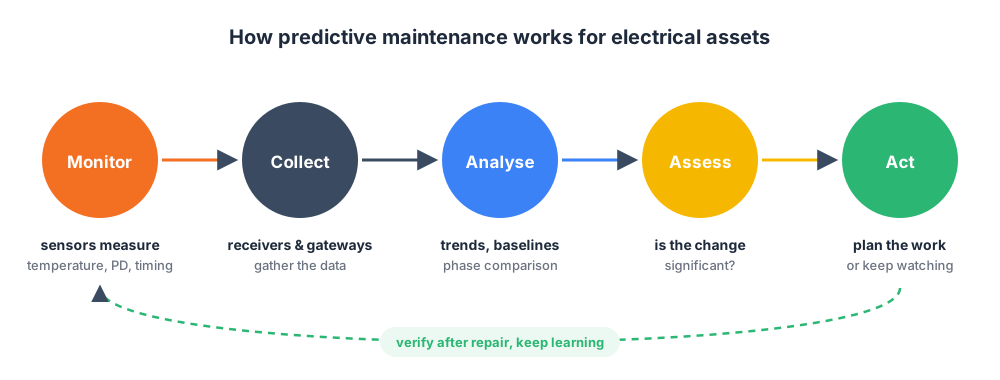
- Monitor: sensors measure the parameters that reveal deterioration, such as joint temperature, partial discharge, breaker operating time or humidity.
- Collect: receivers, controllers and gateways gather readings and pass them to SCADA, a BMS or a cloud platform.
- Analyse: software compares each reading with its own baseline, with similar points (for example, the other two phases), with ambient conditions and with load.
- Assess: engineers decide whether a change is significant, using rate of rise, duration and the criticality of the supply.
- Act: plan an inspection or repair during a scheduled outage, adjust operation, or keep watching. Then compare data before and after the work to confirm the fix.
What to Monitor on Electrical Assets
Predictive maintenance only works where a failure mode produces a measurable early signal. These are the most useful ones for electrical infrastructure:
| Asset | Typical failure mode | Early-warning signal | Predictive technique |
|---|---|---|---|
| Busbar joints and bus ducts | Loose or oxidised connections | Temperature rise, phase imbalance | Wireless busbar temperature monitoring |
| Cable terminations | Poor crimp, insulation defects | Temperature, partial discharge | Temperature sensors, online PD sensors |
| Circuit breakers | Mechanism wear, contact erosion | Slower operation, coil current change, contact heating | Operation counters, timing and coil-current monitoring |
| MV switchgear insulation | Insulation degradation | Partial discharge activity | TEV, UHF, acoustic or HFCT PD monitoring |
| Panels and switch rooms | Condensation, corrosion, overheating | Humidity and ambient temperature | Ambient condition monitoring |
| Transformers | Insulation or winding faults | Dissolved gases, hot-spot temperature | DGA, winding and oil temperature monitoring |
| Motors | Bearing wear, misalignment | Vibration, temperature | Vibration and temperature sensors |
For switchgear specifically, see our guide to high voltage switchgear condition monitoring.
Worked Example: Maintaining a Busbar Joint
Consider the incoming busbar joints of a main LV switchboard feeding a production line. Here’s how each strategy handles the same developing fault, a joint that slowly loses clamping force:
| Preventive approach | Predictive approach | |
|---|---|---|
| How it’s maintained | Annual IR survey; bolts checked and re-torqued in a planned shutdown | Wireless sensors on all three phases, reporting every minute |
| When the joint starts to degrade | Not visible until the next survey, up to 12 months later | Phase B trends 10–15 °C above phases A and C over several weeks |
| Decision | Fault found at the survey, or after it fails | Alarm reviewed, joint inspected at the next planned outage |
| Outcome | Risk of an unplanned outage and damage to the busbar | Joint cleaned and re-torqued; data confirms temperatures back in line |
Takeaway: predictive maintenance doesn’t replace the preventive task of re-torquing. It tells you which joint needs it and when, so the outage is planned and the healthy joints are left alone.
Costs, Savings and ROI
Predictive maintenance costs more to set up but less to run. Widely cited industry figures give a sense of the potential:
| Source | Reported benefit |
|---|---|
| US Department of Energy, O&M Best Practices Guide | Predictive maintenance saves roughly 8–12% over preventive and 30–40% over reactive maintenance |
| Deloitte research, as cited by ABB | Up to 25% higher productivity, 70% fewer breakdowns and 25% lower maintenance costs |
| ABB | Reactive, run-to-failure maintenance can cost up to 10 times more than a planned program |
Your own return depends on how critical the assets are, what an outage costs, and how many intrusive inspections the data lets you avoid. A simple way to estimate it:
Annual value ≈ (avoided outages × cost per outage) + (avoided inspection hours × labour rate) + avoided repair and replacement costs − annual monitoring cost.
For high-cost failure points such as main incomers and critical feeders, a single avoided outage often covers the cost of monitoring. Our guide to battery-powered RF monitoring looks at ROI in more detail.
Standards: NFPA 70B, ISO 17359 and ISO 55000
- NFPA 70B (Standard for Electrical Equipment Maintenance) became an enforceable standard in its 2023 edition. It requires a documented electrical maintenance program (EMP) and ties maintenance intervals to equipment condition and criticality, so condition data directly supports compliance decisions.
- ISO 17359 gives general guidelines for condition monitoring and diagnostics of machines, including how to select parameters and set alarm criteria.
- ISO 55000 series covers asset management systems, the framework in which maintenance strategy decisions are made and reviewed.
- Manufacturer instructions and local regulations still set minimum tasks and intervals that apply whichever strategy you choose.
Always check the edition of each standard that applies to your site, and confirm interval changes with your engineer of record.
How to Choose the Right Strategy for Each Asset
The right answer is rarely “all predictive” or “all preventive”. Decide asset by asset, using two questions: how critical is it, and does its failure give a measurable early warning?
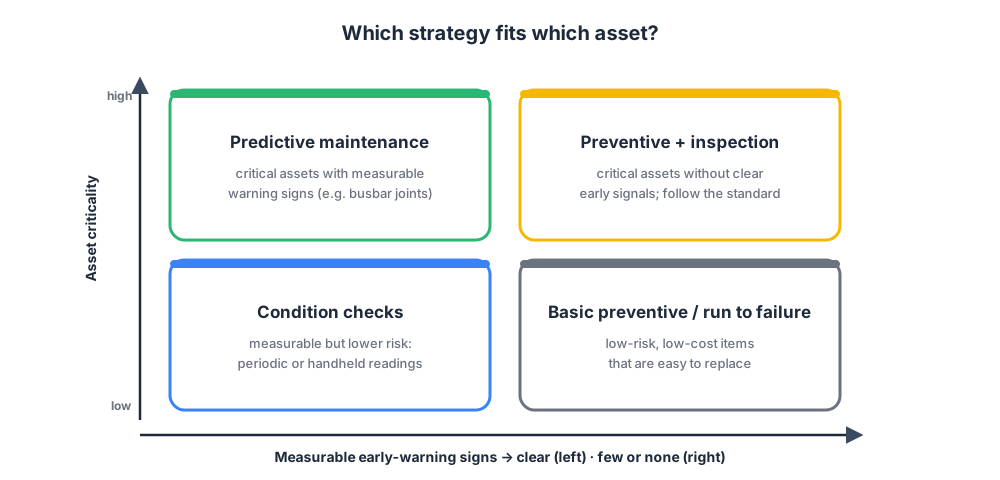
- Choose predictive for critical assets whose failures develop gradually and can be measured: busbar joints, cable terminations, breakers and MV insulation.
- Keep preventive for tasks required by standards or manufacturers, consumables, and failure modes with no reliable precursor.
- Use periodic condition checks (such as handheld readings) for measurable but lower-risk points.
- Accept run-to-failure only for cheap, non-critical items whose failure is safe and quick to fix.
How to Move from Preventive to Predictive Maintenance: 6 Steps
- Rank your assets: List switchboards, MCCs, transformers, bus ducts and breakers, then rank them by the impact of a failure: safety, downtime cost, redundancy and lead time for spares.
- Map failure modes to signals: For each critical asset, identify how it typically fails and whether that failure gives a measurable early warning, such as rising joint temperature, partial discharge or slower breaker operation.
- Start a pilot on the highest-risk assets: Install monitoring on a manageable number of critical points, for example the incomers and main busbar joints, rather than the whole site at once.
- Build baselines and alarm rules: Record normal behaviour across load cycles for a few weeks, then set warning and critical levels, phase-comparison and rate-of-rise alerts.
- Connect data to work orders: Route alarms to the people who act on them, and link findings to your CMMS or maintenance schedule so every alert ends in an inspection, repair or a documented decision.
- Review, adjust intervals and expand: Use the data to extend or shorten preventive intervals where your standard allows, compare readings before and after repairs, and expand monitoring to the next tier of assets.
If you’re weighing when monitoring becomes worthwhile, read When to Upgrade to Continuous Temperature Monitoring.
Frequently Asked Questions
What is the main difference between preventive and predictive maintenance?
Preventive maintenance is performed on a fixed schedule, such as every 12 months, regardless of the equipment’s condition. Predictive maintenance is triggered by the equipment’s measured condition and trends, so work is planned when data shows deterioration and avoided when the asset is healthy.
Is predictive maintenance a type of preventive maintenance?
Yes. Predictive and condition-based maintenance are usually treated as part of the wider preventive maintenance family, because all of them aim to act before a failure. What differs is the trigger: time for time-based maintenance, a threshold for condition-based maintenance, and trends plus history for predictive maintenance.
Is predictive maintenance better than preventive maintenance?
Neither is better for every asset. Predictive maintenance pays off on critical assets that give measurable early warnings, such as busbar joints, cable terminations and breakers. Preventive maintenance remains the right choice for statutory tasks, consumables and failure modes with no reliable warning signs. Most facilities combine both.
What is the difference between condition-based and predictive maintenance?
Condition-based maintenance acts when a live measurement crosses a set limit. Predictive maintenance goes further by analysing how the measurement is trending over time, together with operating conditions and asset history, to estimate when intervention will be needed.
What are examples of predictive maintenance for electrical equipment?
Continuous temperature monitoring of busbar joints and cable terminations, online partial discharge monitoring in medium-voltage switchgear, circuit breaker operating-time and coil-current trending, dissolved gas analysis in transformers, and vibration monitoring on motors are common examples.
What are examples of preventive maintenance for electrical equipment?
Cleaning and inspecting switchgear, checking and re-torquing bolted connections, periodic infrared thermography surveys, insulation resistance testing, breaker exercise and timing tests, and replacing filters and batteries on a fixed schedule are typical preventive tasks.
How much can predictive maintenance save?
Results vary by site, but widely cited figures from the US Department of Energy’s O&M Best Practices Guide put predictive maintenance savings at roughly 8–12% over preventive maintenance and 30–40% over reactive maintenance. Research cited by ABB from Deloitte reports up to 25% lower maintenance costs and 70% fewer breakdowns.
Does NFPA 70B require predictive maintenance?
NFPA 70B, which became a standard in 2023, requires facilities to have a documented electrical maintenance program and sets maintenance intervals based on equipment condition and criticality. It doesn’t mandate a specific predictive technology, but condition data supports the condition assessments the standard relies on. Check the current edition for exact requirements.
Do I need AI for predictive maintenance?
No. Many effective predictive programs rely on clear trends, baselines, phase comparison and rate-of-rise rules. Machine learning can add value on large fleets of assets, but good sensors, reliable data and a process for acting on alerts matter more.
Ready to Move Critical Assets to Predictive Maintenance?
Amptronics builds wireless monitoring for busbars, bus ducts, panels and switchgear, from sensors to dashboards. Tell us about your critical assets and we’ll help you plan a pilot that pays back.
Plan a Predictive Maintenance Pilot